Where are they? In this blog post we’ll take a wild stab at our best guess (based on what we have learned over the last 13 years).
The year has come to an end and we are going to ask you to search PetFBI. (If you are on a mobile phone, please search for albums or photos in the menu) Although we have had an incredibly successful year, we have so many dogs that we are still searching for.
A small percentage of the still missing dogs are probably sadly deceased. BUT, we do know that a body is usually found and we encourage all owners to not give up unless they have confirmed physical evidence that their dog is deceased. By far and away, our largest single cause of death is dogs that have been hit by a car (usually when they are being called or chased by well-meaning but misinformed citizens who do not know that you should never chase or call a scared lost dog). Our next most common cause of death is being hit by a train. Scared lost dogs will use the path of least resistance, and railroad tracks often provide a convenient route of travel between their hiding places and food sources. Unfortunately, some dogs are killed when the train comes, but again, a body is almost always found. Our third most common cause of death is drowning; either by falling through thin ice, or by making a poor decision and bolting towards a body of water. Lost dogs that are not being chased, approached or pressured will make wise decisions and may survive indefinitely. Dogs that are being pressured or pursued will make poor decisions and may meet an untimely end.
Many people fear that their dog has been eaten or killed by coyotes. We do not find this to be common and very few of our deceased dogs have evidence of being killed by a predator. Is it impossible? No. But dog/coyote altercations are almost always territorial (the dog is defending his yard or his territory) and scared, lost dogs are not territorial. They will defer to a larger predator. Lost dogs simply want to survive – so they need to do three things – they will hide from predators (including man) and they will spend their time sleeping and traveling between their food sources and hiding places. If a dog is killed by a larger predator – the body will usually be found. Predators do not tend to eat other predators and all members of the canine family are predators.
Where are the other still missing dogs? Some are still “out there” as described above. Scared and living in “survival mode”, these dogs may be rarely seen because they have become so adept at hiding and may be mostly nocturnal. Eventually they will start to hang around one or more reliable food sources (often a farm that is leaving food out for outdoor cats). If they are left alone they will become more domesticated and may be seen during daylight hours or even attempting to play with neighborhood dogs or farm dogs. This is why it is SO important to continue to flyer in an ever-increasing radius of where your dog went missing from. Somebody, somewhere WILL see your dog and they need to know who to call when they do.
Some of our still missing dogs wandered far beyond their “jurisdiction”, out of the flyered area, and end up in the maze of animal sheltering and animal control. They may have been adopted to a new family or put down when their 3 or 7 day stray hold was up. These are a heartbreaker for us because the simple of act of posting pictures on line of impounded found dogs would bring most of these dogs home. Our dedicated volunteers and fans scour the internet watching for possible matches but they cannot do this when there are no pictures available. Many Illinois shelters still do not reliably post pictures of impounded found dogs. Please ask them to do so. It is perhaps the simplest way to save lives and free up shelter space for those dogs that truly need it.
The last component (and probably the largest) are lost dogs that have been picked up by a Good Samaritan who meant well but then kept or rehomed the dog without searching for the owner. Of course, this is illegal in Illinois, but it happens all too frequently. The current “rescue” phenomenon that is sweeping our country has kind -hearted people making false assumptions about the owners of a dog they find. They speculate that the dog has been abused, neglected or “dumped” and needs a new home. We have great success when we can get the finder to file a report with us so that we can post a flyer online. This serves to dispel the false notion that people that have lost their dog don’t deserve him/her back. We ask all of our fans to please spread the word to their friends, family and neighbors – Lost dogs don’t need a new home. They just need to go home. Do not assume that you can keep a dog that you find. He/she is somebody else’s personal property and keeping him/her is illegal.
Thank you for helping us. Please take a few moments, scroll through our missing dog albums, and maybe, just maybe we can help reunite a few more of these dogs in 2024.
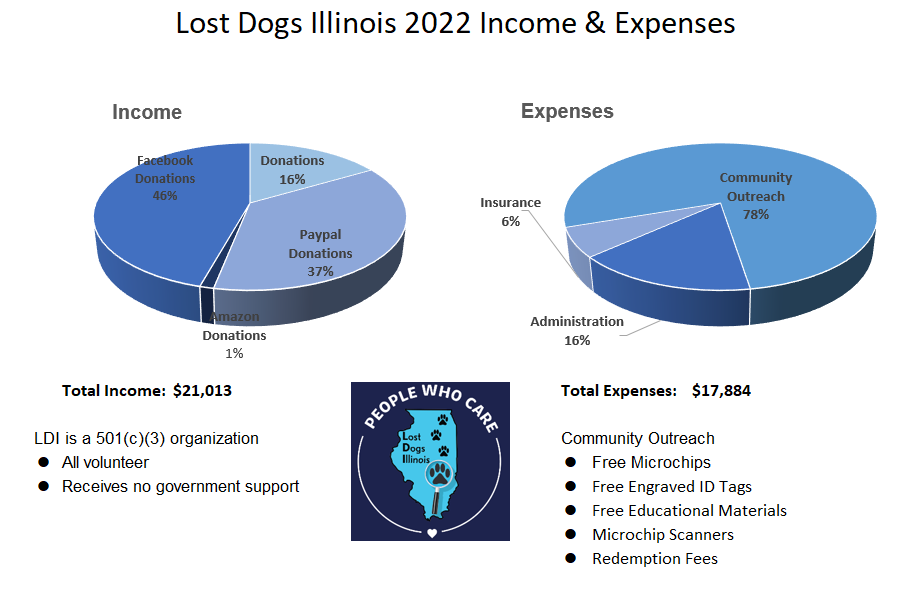
Here is the breakdown of Lost Dogs Illinois’ 2022 Income and Expenses. Our Not-For-Profit group is made up of volunteers spending countless hours on our mission of reuniting lost dogs with their owners. As you can see, not only do we post the dogs on our Facebook page, Instagram and Twitter feeds, but we are also involved in Community Outreach programs, mostly in under-served areas, in which we provide microchips as well as ID tags and educational material. Lost Dogs Illinois has also used funds to provide microchip scanners to police departments and helped owners with reclaim fees. We want to thank our various supporters including donors, fans, volunteers, vet clinics and animal control facilities for making all of this possible. We could not do what we do without all of you!
From Tip to Tail, a Podcast sponsored by Cuddly’s and Dedicated to Animal Welfare
Susan Taney, Director of Lost Dogs Illinois, joins from Tip to Tail to discuss the evolution of animal welfare and the importance of microchipping our pets.
Topics Include:
Susan’s journey in animal rescue.
The evolution of animal welfare.
Tackling myths surrounding animals.
The power of community to find lost dogs.
Suspending judgment of pet owners until we know their backstory.
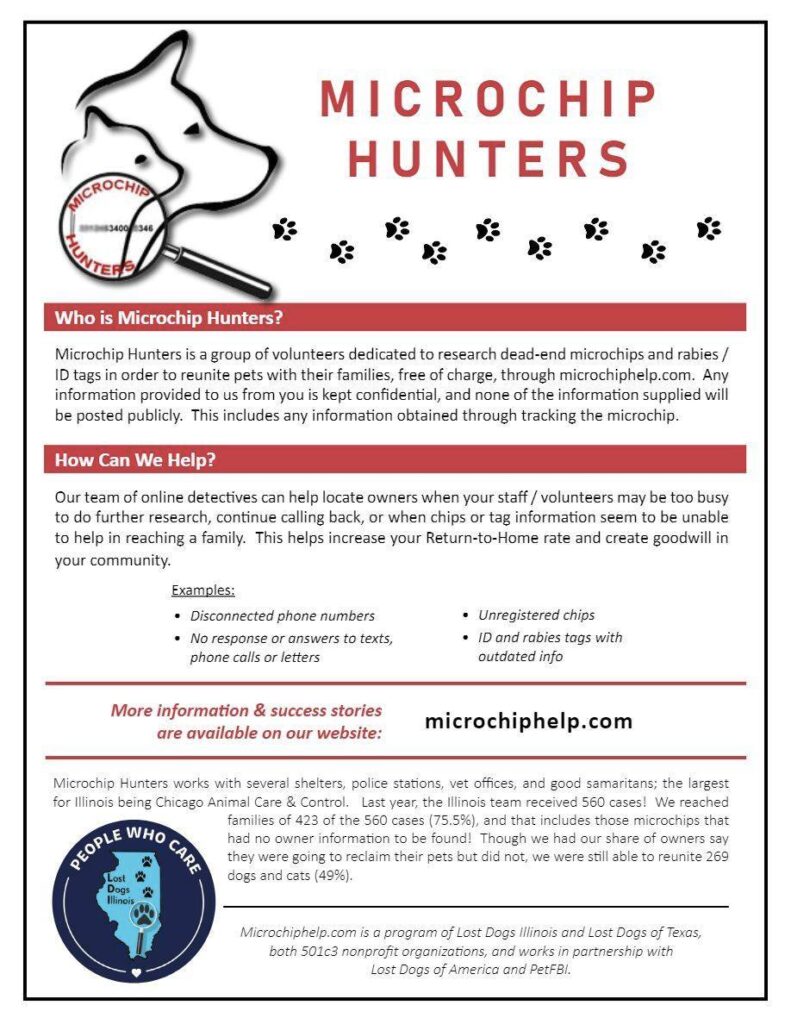
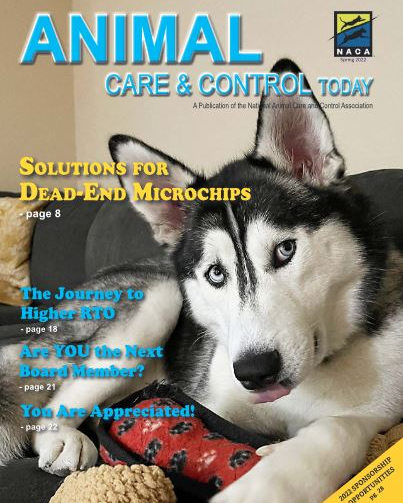
Great job Jeanette Garlow of Lost Dogs Illinois on this article, Solutions for Dead-End Microchips, featured in the Spring 2022 issue of the NACA Animal Care & Control Today Magazine which discusses the fantastic work being done by Microchip Hunters! You can download a PDF of the magazine and read it on Page 8.
One thing I’ve heard quite a few times in recovery is that the terrier breeds are really the toughest ones out there. Being a Boston Terrier, and a puppy mill momma, Annie did not disappoint.
Annie
I had first reached out to Annie’s parents when I saw a post on one of the Yorkville pages. Being as I live in Yorkville, I couldn’t not. I spoke with her dad Mike. Found out she got spooked on a walk and around the corner from home and backed out of a harness. I gave them some pointers and they had done quite a few things already; reached out to police, AC and vets in the area, had scent items and food out at home, and had gotten flyers made and up in the area. I offered to put a camera up at home, but they informed me they had a Ring camera and were good.
Over the next couple days I kept texting with Mike, offering pointers; lots of pointers. I do try not to inundate owners with information but as we all know time is of the essence and the sooner some steps get done the better the chances of recovery. But this case was a good reminder that the suggestions and points we give to owners fly out of my mouth with ease and sometimes, most times, it’s very overwhelming.
Mike continued to inform me that they were good. So I respected that, as hard as it was.
There were no sightings from Sunday until Wednesday the 23rd. They had received some sightings in the subdivision right next to theirs, literally blocks from home. Again, I reached out to Mike, explained the importance of getting the pertinent information, date/time, EXACT location and direction of travel. He said thank you and I didn’t hear back.
In the meantime, LDI had reached out to ask if anyone could assist with a lost dog in Yorkville, that the family had reached out to ask for a trap. I mentioned I had talked with the owner and let them know I was still available.
And in another piece of the puzzle, one of the women who called in a Wednesday sighting, Kim, had been communicating with Cindy, Annie’s mom. She reached out to her friend Liz, who knew that Deb did recovery, and asked if Deb was available. Deb knew that I had been reaching out to Mike, and made the connection.
By Thursday, we had an active messenger chat going with Liz, Kim, Cindy, Deb, myself and Kelly, our friend who also offered to assist. We finally had everyone communicating together, finally had figured out the sightings, and began to see Annie’s patterns, or at least where we thought she might be hanging out.
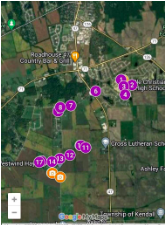
She went missing from the Raintree Subdivision on the east side of Rt 47, south of Rt. 71. By Wednesday morning, 8:30 am she had found herself on the west side of Rt. 47 approximately 1.5 miles as the crow flies. By 9:30 am that same morning, she was back in her subdivision just blocks from home. A second sighting in the same general area came in around 10:15 am. That caller witnessed Annie in her frantic state, and in a frightened effort to escape, Annie ran back west across Rt. 47 a second time. The caller followed in her car, taking a couple pictures along the way. The last sighting was back in the area of the 8:30 am sighting, running full speed between a couple houses near Legion and Immanuel.
The weather did not cooperate the next couple days; cold, rain, snow, wind. More flyers had gone up in that general vicinity but unfortunately there were no sightings called in for three days. Our hope was she had found some place to bed down and stay safe and warm. There were plenty. Open barns, under decks, abandoned properties. That was great for her, tough for us!
We set up cameras and a feeding station at the last know sighting area. Nothing on camera either.
Sunday at approximately 1:00 pm, the owners received a call. Annie was seen walking east on Ament Road near the cemetery. The caller was in his car. He stopped, she stopped, and then she turned, running full steam west bound on Ament Rd. heading toward Immanuel. This caller again followed her. She headed south on Immanuel and turned west bound the first chance she got on Deer Crossing Drive. By the time he got to see which direction she went, he said she headed south, along a pond and over a berm. She was gone again.
Sightings Map
By this time Annie’s owners were catching on. They were starting to understand what we meant by “survival mode” and what we meant by having them ask people not to follow her or chase her or call out to her. It was pushing her further. They went and handed out flyers to all properties in the surrounding areas, talked to property owners and made sure everyone was aware.
I had stopped at one last house on Ament Road, near the cemetery, to drop off a flyer. Later that evening, Mike and Cindy received a call from that property owner. He had cameras. Boy did he have cameras. And after receiving the flyer, he checked them. Annie had been on his property at noon on Saturday, at 8:00 am Sunday morning for at least a half hour, then seen almost in front of his house on Ament Sunday afternoon.
We moved cameras and feeding stations to his property that night. A trap was also placed out there and zip tied. But Annie didn’t re-appear. Neither Sunday night nor Monday morning. A step behind her again.
Monday, our angel farmer Bob called. Annie had been seen laying at the edge of an empty stable he had, laying on her side, sunning herself. The odd thing is that just that morning, Annie’s mom had posted a picture in our chat of when they had first gotten her, laying on her side, sunning herself. When he went in to get the flyer he had to call, she got up and trotted west into a field. Cindy and Annie’s brother Paco headed that way. When they got there, Cindy saw Annie. She was on the far side of a horse corral at the property next door. Paco decided to start barking at the horses, and this caught Annie’s attention. At this point she started heading for her mom and Paco, but for reasons unknown, she stopped, and turned and trotted away once again. I think this was when it really hitting her mom. It is so emotional to see your dog, but not have her come to you, and watch her walk away. Many of us understand this completely.
We moved equipment that afternoon. We put out a trap with a camera on it and one facing the entrance to the stable. We had her bed, scent items, liquid smoke and really good food trailed from the fields she was seen in, to the stable. We were ready for her. At this point we weren’t sure if this was just a pass-through spot, or if she knew to return for shelter. Either way we were ready.
Annie was a no show that night. But the next morning, the 29th, when her mom went to refresh the food, she saw Annie again. At this time she was still on the property to the north. Cindy tried again to lure Annie, using Paco on a 50’ rope, but she still wouldn’t come close enough to smell either of them. Minutes after she was seen by Cindy, she was on camera!! She didn’t go in the trap, but we could tell she wanted to. We didn’t get her on the camera facing the opening of the stable. We were confused as to how she got in. Then our angel farmer Bob saw her in the fields to the south of his house and she crossed to a property across the street with junk cars, open barns and trailers. Mom went over there for one last attempt but Annie didn’t come out.
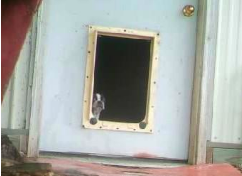
Turns out there is a service door on the side of the stable with an actual doggie door. We put a camera on that door as well. Food was refreshed and using Deb’s magic gravy, a heated bowl (angel farmer Bob had power and an extension cord for us to use!) we made sure we had the best waiting for her. We even built a little wind block because the forecast for Wednesday was rain and wind, 100% of the time, all day.
Doggie Door to the stable
At 5:00 am on the 30th, Annie decided to check out the smells and food at the stable again. She did enter through the doggie door just as we had suspected, and finally entered the trap! She spent a good 9 minutes in there, eating everything in sight. She was the stable a good ½ hour, then wandered off to the north to wherever her resting place was.
Wednesday it rained. All day. Until 2:45pm or so when it finally broke. Annie showed up at 2:53 pm. But the trap was zip locked open, and food hadn’t been refreshed since the morning but for a very small bit. We were hoping to set up to trap that night, so wanted her hungry.
We scrambled to find someone who was available to get there, to try to set the trap but not spook her away. Kelly was closest and able to get there the quickest. Deb was able to leave work shortly after and headed that way as well. We were in touch with Kelly as she got there, but still hadn’t seen Annie leave the stable. In fact, her head was buried once again in the bowl in the trap, licking every last morsel of warm food and gravy in there. And that’s exactly where she was when Kelly walked up. The trap was still zip tied, so Kelly’s quick wit told her block the entrance. And that’s what she did. Annie was startled to say the least at first, but Kelly was able to scoop her up and get her safely in the truck. And we got to watch it on camera!
At some point Kelly was going to swing by Mike and Cindy’s to pick up more scent items for that evening’s trapping. Instead, she called her to let her know she was on the way…and surprised them with their baby girl!!! Annie was safe after 10 days out!!
Lessons learned:
Fide Canem – Trust the dog. Trust that they will take care of themselves. Trust that if let to be, they will find food, shelter and water. Annie traveled over 7 miles that we were aware of. There were four days we had no idea where she was.
Trust the process – but remember we can recite the process in our sleep. Some people need time to absorb, time to trust. We laughed about it after. I believe the word Cindy and Mike used to describe me in the beginning was “fanatical”. I get it. I’m just glad they eventually allowed me and the crew to help.
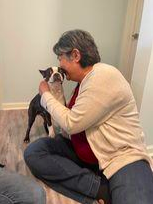
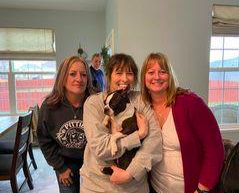
Reunion Photo
Many, many thanks to the Yorkville community, to Kim, Liz, and Mike and Cindy for trusting us, Katherine, Aynn, Chris for sightings and of course our angel farmer Bob. We absolutely cannot do this with out the help of the village. Once again.
Deb, Kelly, Elaineand of course, Annie
Thank you Deb, Kelly & Elaine for sharing Annie’s story.
Tuesday, January 26th, 2021, 1400 hrs. Mom has me out to help shovel. I don’t think so! Then tells me it’s time for a walk. It’s a balmy 34 degrees and I’m feeling adventurous. She tells me it’s time to switch leashes…she clicks, I twist…SUCCESS! I’m free!!!! Run Frasier Run!! Off to the field I go…WAIT! WHAT IS THIS COLD WHITE STUFF?? Ooop! Here she comes…let’s book it.
I’ll head towards the houses…I think I know these ones. We pass them on our walks. Mom will know where to find me…lets see if she can catch me. I think she’s calling for me. But I’m having too much fun frolicking through the snow.
Huh, I can’t see my Mom. I’m sure she knows where to find me. Dang these houses all look the same! But I can sort of smell something familiar. Just not quite sure where it’s coming from. She still hasn’t found me, and it’s starting to get dark…and cold…
At last! I found my home. I think. It’s really dark out now… MOM!! I’m here MOM. Open up I’m here!!! I’ll leave my footprints on the back patio so you know I was here!! I’m done on my adventure Mom! Please open the door! It’s cold…
Meanwhile, Frasier’s Mom sat, devastated she failed him. She had food out by her front door, his blanket, his bed…If he visited that area it was hard to tell since the snow had been shoveled. But he was definitely at the back door overnight. His footprints were all over the patio, then went to the north, up a berm, into some trees and stopped at the very busy 2 lane road behind the house.
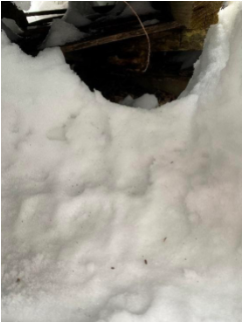
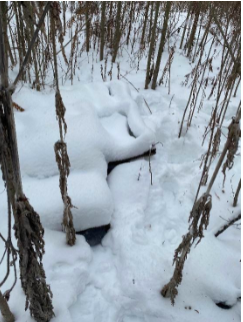
Wednesday, January 27th, 2021, 0900 hrs. I’m not sure what to do now. I’m a little hungry. And cold. I suppose I should look for a place to rest. I’ve been up all night trying to figure out what to do. There’s a quiet area of woods right here so I’m going to explore them. Ah ha! I found a perfect spot. Piles of wood, or something. I can probably dig in here and rest for the day. And maybe the night. I’ve got to come up with a plan…
Thursday, January 28th, 2021, 1400 hrs. DANG! I’ve been spotted. People saw me when they were on that busy road! They got out of some big machine and called to me. I had just woken from a nap under this warm deck on the front of this white house. The sun was out and I was feeling good. I must run!!
I don’t know them. I’m hiding back in the woods. It’s dark again now but I see my mom. She’s there with another person. They are looking around my deck, maybe they see all my paw prints. They put some big metal cage out. What are they looking for?? What are they trying to catch?? Wait a minute…I know what that box is. NO WAY…not gonna go near that again! That thing almost ATE me last time!! (This was Frasier’s second time adventuring out)
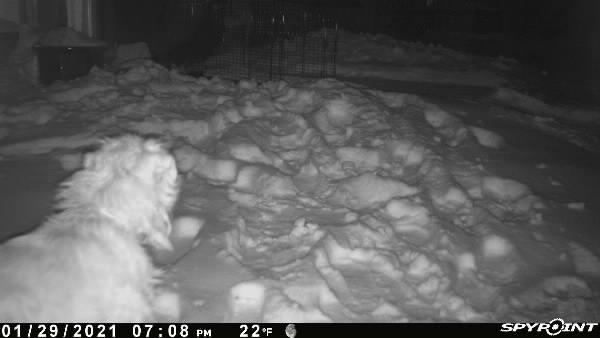
Friday January 29th, 2021, 1130 hrs. I found it, at least I think I did. My home. I’m not sure tho. It kinda smells like my yard. I’ll run around here again and leave my footprints. There’s food here. Pieces of my favorite kibble and some treats!! I’ll gobble all that up, but I’m still hungry. I’ll just walk where there’s no snow right now, see if I can find some more food. It doesn’t hurt my feet as much. I miss my Mom. I hope she misses me too…
Little did Frasier know just what his mom was up to. She had begun to plaster the area with flyers. In fact, the people who saw him at the white house drove not ¼ mile and saw his flyer and called his mom. A block away from home, someone working at the nearby farm had seen him walking down the street. Another person saw a flyer and called to say they had seen him that day in the conifer trees that lined the back of the houses near where he lived. People were starting to look for him.
Friday, January 29th, 2020, 1900 hrs. I found it again!! I found my….what in the world?? Another big metal box?!? Fool me once shame on you, fool me twice, shame on me!! Not happening. I’m cold, I’m hungry but I am afraid of that thing!!! I’d better go back to my safe spot. I’ve learned to go across the bigger road when it’s darker, and the big machines slow down. I’m tired. This isn’t really fun anymore.
Fraiser’s mom and team realized since he was trapped the first time he was trap shy. They decided to camouflage the trap as much as possible. The weather started to turn and a snow storm came in January 31st. Two days, no sightings, but not uncommon with the storm that came through.
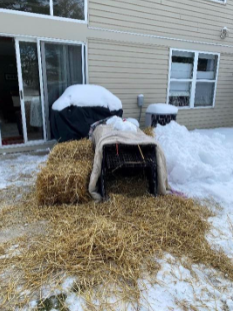
February 4th, 2021 Camouflaged trap – straw was added as the weather was predicted to turn colder.
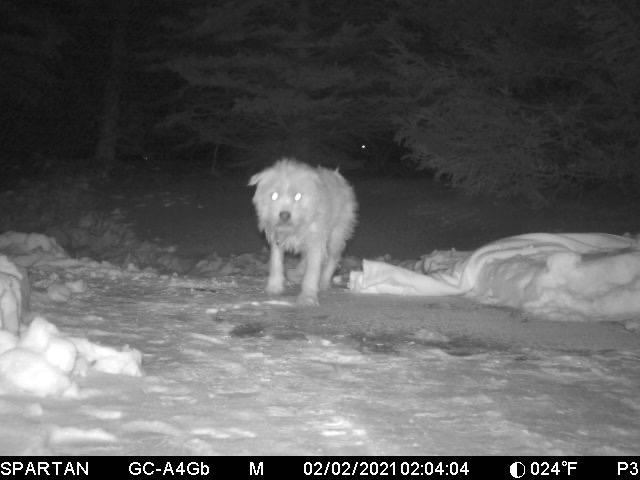
February 2, 2021 0200 hrs. I’m here! Mom I’m here. I’m leaving my prints, I’m eating the food but I don’t like this thing on the porch. I want to come closer to the doors but that thing is new and even though it has food I really don’t like it.
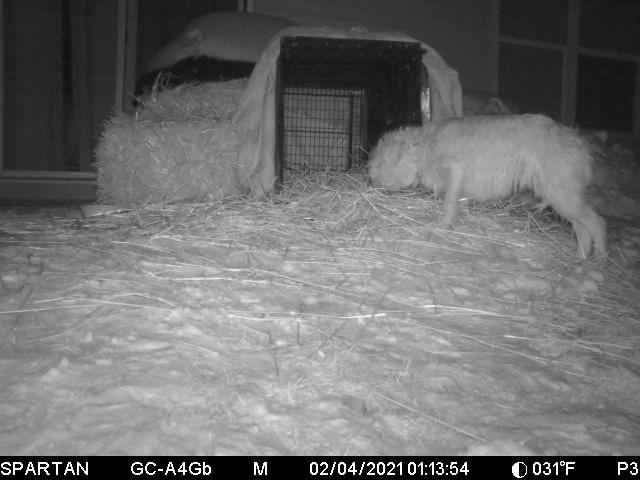
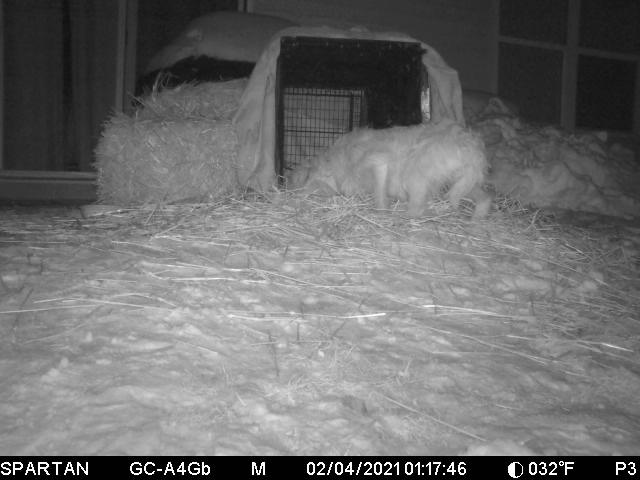
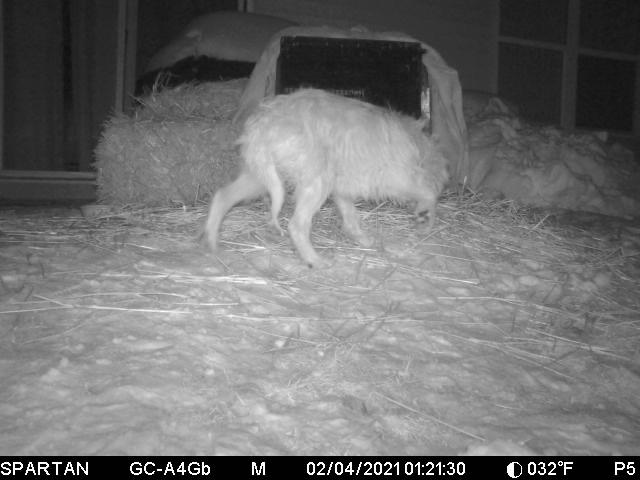
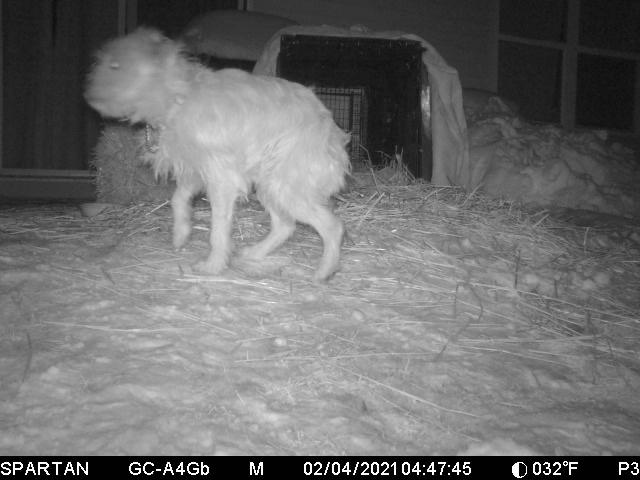
Frasier continued to come overnight. 2/4/2021 he was on camera 0115 am, 0500 am, 1030 pm, and 2/5/2021 at 0530 am. At this point the team knew there had to be a change of plans. He wanted nothing to do with the box trap.
Brainstorming took place and it was decided a missy trap needed to be used. The problem was, Fraiser was coming overnight, and as we all know, it’s difficult to take a trapped pup out of the missy if you aren’t experienced. Mom was more than willing to stay up and watch the trap, but the closest recovery team member was over ½ hour away, and it was too cold to leave him in there that long. What to do…
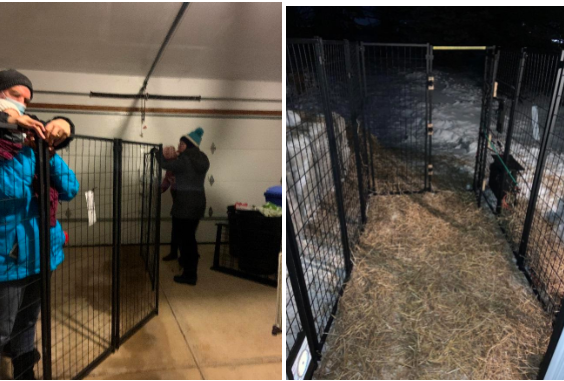
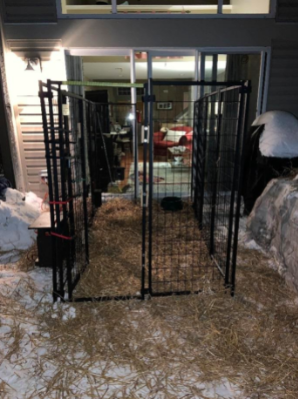
The team decided that the best thing to do is make him as comfortable as possible. He came to the sliding doors, he knew where home was, so it was decided the best plan was to build the missy trap OFF the sliding doors. That way, if he did get trapped, his foster would be able to stand to the side and hopefully slide the door open without spooking him too much and he’d come in. A team of mom’s close friends gathered the evening of 2/5/2021 to assemble the missy. It was cold. Time was of the essence. The missy was set up with the door and two sides, and the back side against the sliding doors.
The temperature had stated to plummet. A George Foreman grill was used to keep the food hot and smelly along with a plug in heated bowl. Frasier’s blanket, mom’s clothes and hot food were all out and ready by 1000 pm.
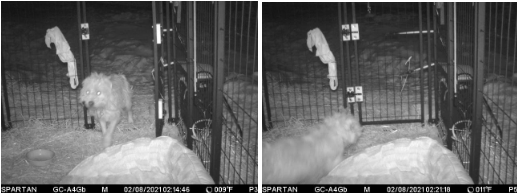
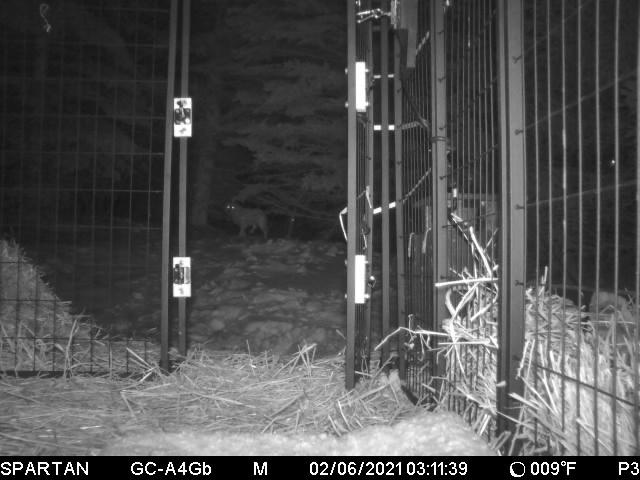
Frasier didn’t disappoint. 0500 am 2/6/2021. Look closely.
What the WHAT??? Really MOM??? NOPE, Not doing it… but man that food smells GOOOOOOD!!
One of the team members and Frasier’s mom stayed up most of the night of the 6th, taking turns to see if he showed. Unfortunately, he didn’t get too close to the trap until early in the morning. Still, he would not step in. Everyone was getting concerned as the temperature on the 7th was predicted to be 5 above with the low at -9 degrees that night.
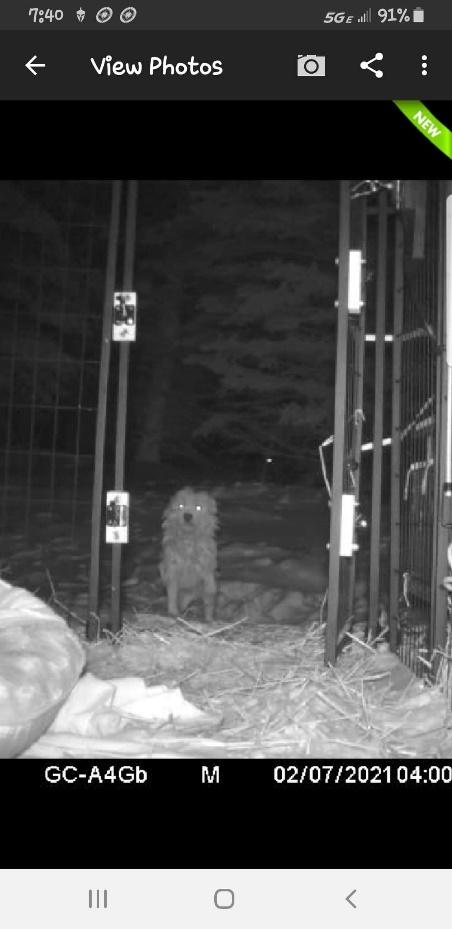
24 hours later. 2/7/21 0400 am.
I’m being brave mom!! I’m really trying! I want to come home, but I’m scared! But I’m hungry!!
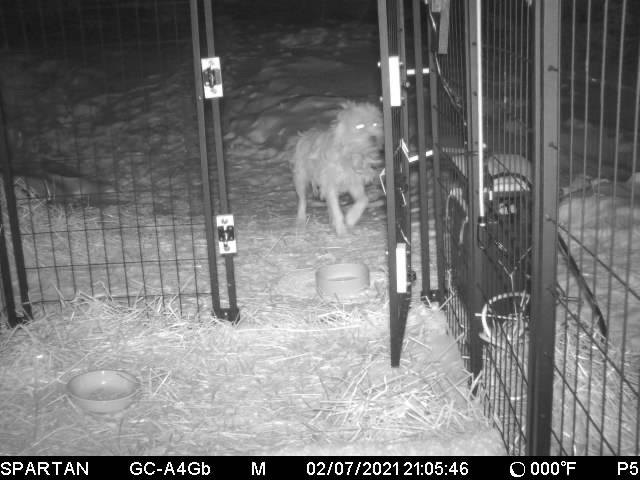
2/7/2021 9:00 pm temperature was hovering around zero degrees.
Thank you for the food mom! I promise I’ll come back and eat more. I promise I’ll try to get closer!
Frasier’s mom was ready. One of the team members was ready. Camera notifications were on full volume, phone’s close. Bacon, hot dogs and warm food on the grill were ready. It’s time!
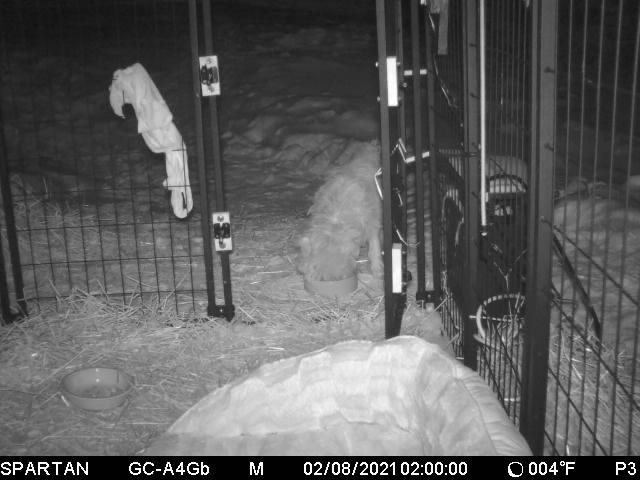
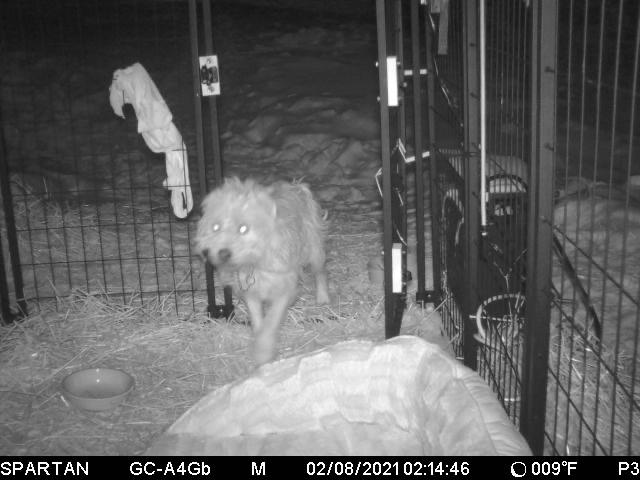
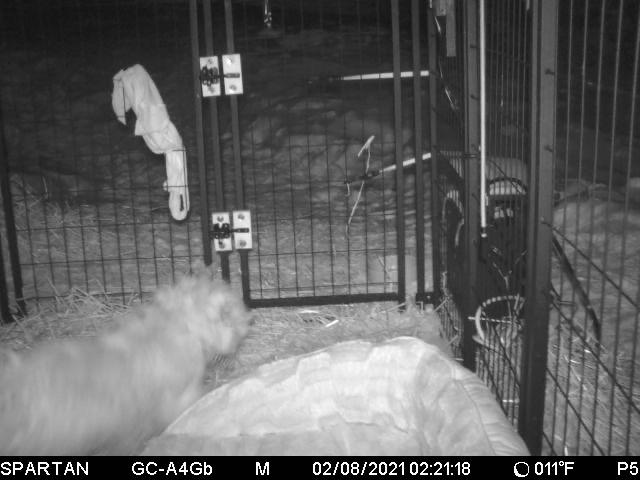
Frasier didn’t disappoint. 2/8/2021 0200 am. He at the cold food in the bowl, but the hot food was just too good to pass up. Trap closed at 0221am. FRASIER WAS SAFE.
Mom was able to slide the door open and he went right in. Never underestimate the survival skills and instincts of any dog. Stories like these happen all the time. Sometimes you just have to think outside the box and stay a step or two ahead. Today marks his one-year trapaversary! He’s come a long way. From shy and skittish to sitting on his mom’s lap enjoying scratches. Happy to be home.
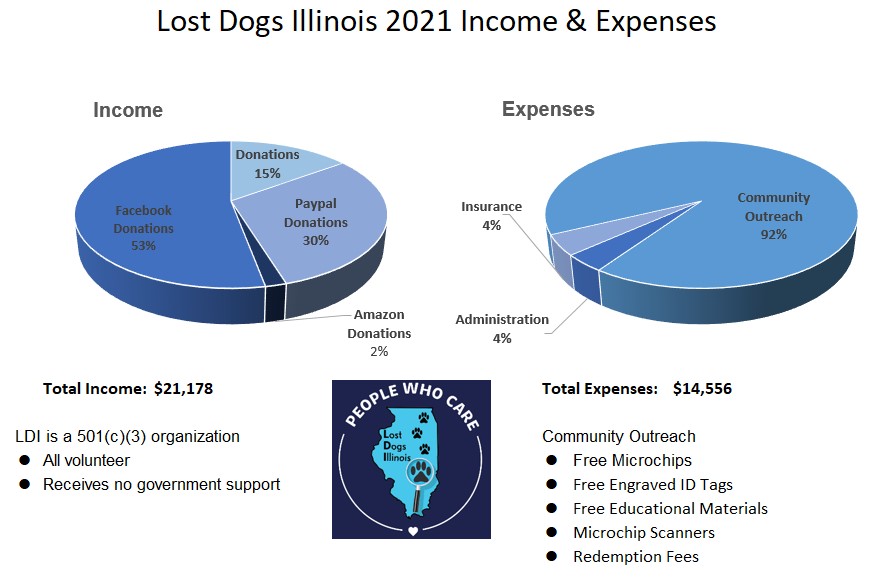
Here is the breakdown of Lost Dogs Illinois’ 2021 Income and Expenses. Our Not-For-Profit group is made up of volunteers spending countless hours on our mission of reuniting lost dogs with their owners. As you can see, not only do we post the dogs on our Facebook page, Instagram and Twitter feeds, but we are also involved in Community Outreach programs, mostly in under-served areas, in which we provide microchips as well as ID tags and educational material. Lost Dogs Illinois has also used funds to provide microchip scanners to police departments and helped owners with reclaim fees. We want to thank our various supporters including donors, fans, volunteers, vet clinics and animal control facilities for making all of this possible. We could not do what we do without all of you!
Survival and flight mode are terms being used more and more by lost dog recovery specialists but the meaning of those terms is not clear to a lost dog owner or general public helping to find a lost dog.
Lost dogs, even the friendliest dog which has been missing for a period of time, will start using their natural instincts in order to survive. When dogs begin to use their natural instincts, their behavior towards humans changes and they become focused on three things; food/water, shelter and keeping themselves safe from perceived threats, which sadly can include his/her owner/good Samaritans.
Even when approached or called by an owner/good Samaritan the dog is instinctively fearful and runs away from the “threat” often leading to the person chasing the dog. Each time something like this happens it increases the dog’s level of fear towards people. When this behavior is being exhibited the dog is said to be in survival or flight mode. The dog will do whatever it needs to do to escape the threat whether that be disappearing into the woods or frantically running into traffic. Unfortunately that is when they make poor choices.
So what can you do? Educate, educate, educate! Get the message out to the public verbally or on your flyer by describing the dog’s behavior in simple terms they can understand, such as, “Do not call, approach or chase the dog, he/she is extremely frightened and will run away from you.” Direct the person to instead call and report the sighting immediately.
Finding a deceased dog is an unsettling experience. We appreciate everyone who recognizes that deceased dogs are probably beloved family members. Handled correctly it can give an owner closure and a sense of peace to at least know what the outcome was for their missing pet.
First and foremost make sure it is safe for you to do the following steps. If the dog’s body is on a roadway or in the ditch of a busy road, it is better to just make note of the location and contact the police or the local animal control agency. Don’t risk getting hurt or causing an accident.
If you can approach the deceased dog safely, here are some tips to help find the owner. It is always helpful to have a pair of disposable gloves in the car to use. If you are at all squeamish you may want to ask for help.
Immediately take several photos of the dog from different angles. Note whether the dog has a collar and tags on. If so, get as much information from the tags as possible. Even a rabies tag can provide useful information. If possible, take photos of the tags as well. Note the size of the dog, gender and length of hair. Note any possible trauma to the body.
Note the exact location of the body. This will help an owner or local authorities to retrieve it. You must be very precise because it can be difficult to spot a dog’s body on a roadway or in a ditch when driving. Also consider that scavengers may start to eat the carcass and it may become less recognizable as time goes on. If the dog is on a busy roadway you may want to move it off into the ditch to prevent further damage to the body. Again, be very careful doing this. Make sure it is safe for you to do this without potentially injuring yourself or others.
Ask local authorities to take the body to be scanned for a microchip if they don’t already routinely do that. Bodies should never be buried or cremated until they have been scanned. If the microchip appears to be a dead end or unregistered use our free service to help find the owner by filing a report with Microchip Help
Write up a description of what you have found and file a report with our partner, Pet FBI at www.petfbi.org. Include any photos that you took. We will post a description on the appropriate state page. The pictures will be masked so someone wanting to view them will have to click through to see them. The listing will also be put into a centralized database which will help any potential owners who are searching for their dog.
Check our listings at www.petfbi.org as well as any other lost and found listings in the area for possible matches. Consider that the dog may have been lost a long time or may have travelled and crossed county and state lines.
Click on this article to learn more about the stages of decomposition of a deceased animal.
 S
S